Follow Equipment Reporters in Google Search
- Hours show time, not care or load
- Chains and forks are safety items
- On electric trucks the battery is the big cost
- Records and wear should match the meter
Why the Meter Is Only a Start
Forklift hours tell you how long the truck ran. They do not tell you how heavy the loads were, how rough the floor was, or how well it was serviced. A truck that moved light boxes in a clean warehouse ages very differently from one that hauled heavy loads in a lumber yard.
So the better question is not how many hours is too many. It is what is worn, whether it is safe, and what it will cost to fix. Some parts of a forklift are measured against limits set by the maker. Those numbers matter more than the meter.
Know What Kind of Hours You Are Reading
Not every forklift counts hours the same way. Some meters run whenever the ignition is on. Others count only when the truck drives or lifts. Many electric trucks keep more than one count, such as key hours, drive hours and pump hours. Ask which number you are looking at.
A truck with many key hours but few drive hours may have spent a lot of time sitting on with the key on. That is not the same wear as hours spent driving and lifting.
Gas, Propane and Diesel Trucks
On an internal combustion forklift, the engine and transmission carry most of the cost. On a common truck like the Hyster H50FT, Yale GLP050 or Cat GP25, check these.
- Transmission. Drive forward and back. Watch for slip, slow engagement or a hard clunk when changing direction.
- Engine. Cold start, smoke, blowby and how it runs under load.
- Cooling. A clogged radiator is common in dusty work.
- Propane system. The tank, regulator and lines should pass a leak check.
Electric Trucks and the Battery
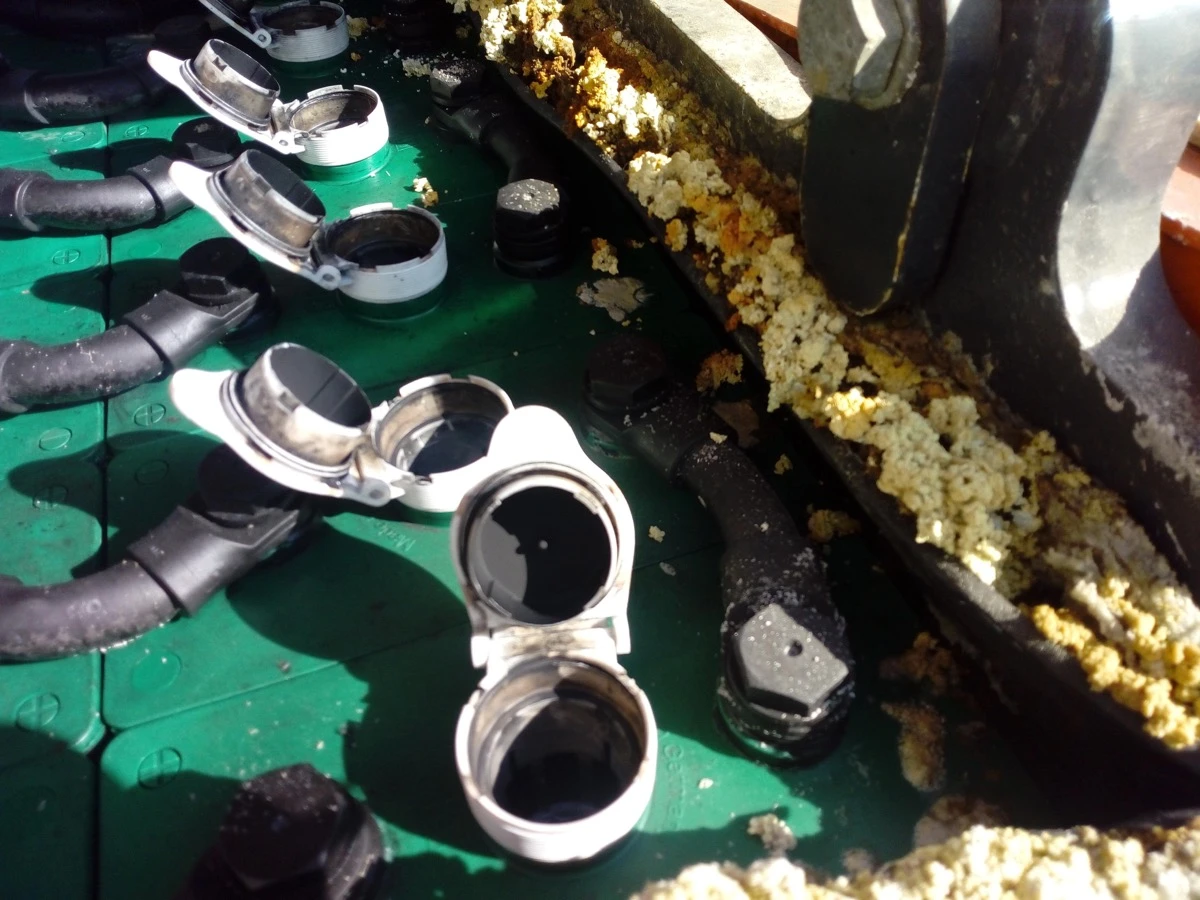
On an electric forklift, the battery pack is often the single biggest cost. A tired pack can quietly cut the value of the truck. It also cuts how long the truck can run on a charge.
Ask how old the battery is and whether it has a watering record. Then have it load tested. Check the charger too, and make sure it matches the battery. On trucks like the Crown FC, a Crown RR reach truck or a Raymond reach truck, also check the drive motor, the controller and the load wheels. Scan the controller for stored faults.

Chains, Forks and the Mast
These are safety items, not just wear items. Worn ones can drop a load.
- Lift chains. Chains stretch as they wear. They are measured with a chain gauge and compared with the maker's wear limit. Parts maker TVH says leaf chains must be replaced at 3 percent stretch, or 2 percent in the UK and the Netherlands (TVH).
- Forks. Fork blades get thinner at the heel, where the blade bends up. A thinner heel means less rated capacity. A fork caliper measures it. The Industrial Truck Association recommends pulling a fork from service once the blade is 10 percent thinner, and a Yale engineer wrote that a 10 percent loss cuts capacity by 20 percent (Plant Engineering, May 11, 2011). Also check that the forks are not bent, cracked or uneven at the tips. Fork maker VETTER says the tips should not differ in height by more than 1.5 percent of the blade length (VETTER).
- Mast. Look at the rollers and channels. Raise and lower the mast fully and listen for binding or jerky movement.
Chains and forks are not expensive compared with an engine or battery. But if they are past their limits, plan to replace them before the truck goes to work. VETTER also says forks should get a full inspection at least every 12 months, and more often on multi shift work. Ask when that was last done.

Hydraulics, Brakes and Tires
- Drift. Raise a load and hold it. If the mast creeps down or tilts forward on its own, the cylinders are worn.
- Leaks. Check the lift and tilt cylinders, hoses and the pump.
- Brakes. Test the service brake and parking brake on a ramp if you can.
- Tires. Cushion tires can chunk and wear flat. Pneumatic tires wear and crack. Both are common costs.
- Safety gear. Horn, lights, seatbelt, backup alarm and overhead guard should all be there and work. Some trucks, like the Toyota 8-Series, also have a stability system that should show no faults.
Matching Hours With the Wear
The last step is to see if the story fits. Low hours on a truck with worn pedals, a torn seat, stretched chains and worn forks do not add up. High hours on a truck with service records, a newer battery and chains and forks within limits may be a fine buy.
Ask for service records and the daily check sheets. OSHA says a forklift at work must be examined before it is placed in service, at least daily, and after each shift when it runs around the clock (OSHA 29 CFR 1910.178(q)(7)). A fleet that kept those sheets usually kept up the truck too. Ask what kind of work it did and how many shifts it ran. Ask whether it came from a rental or lease fleet. Then compare the answers with what you see.
Want it measured for you? Our forklift and material handling inspection checks chain stretch, fork wear, hydraulics and the battery or engine, and gives you a photo report. The same thinking applies to excavator hours and other machines.
Where the Facts Live
| What we cited | Where it came from |
|---|---|
| 29 CFR 1910.178, Powered Industrial Trucks | OSHA, accessed October 2026 |
| Don't Overlook Your Forks in Maintenance Inspection, Lou Micheletto, Yale, May 11, 2011 | Plant Engineering, accessed October 2026 |
| Inspection of Fork Lift Forks | VETTER, accessed October 2026 |
| 5 Tips to Easily Maintain Your Forklift Chain | TVH, accessed October 2026 |
FAQ
- Is a high hour forklift a bad buy?
- Not always. A forklift with high hours, good records, a healthy battery or engine, and chains and forks within limits can be a solid buy. Judge it by the wear, not just the meter.
- What costs the most on a used electric forklift?
- The battery pack is usually the largest cost. Ask its age, look for a watering record, and have it load tested before you buy.
- How do I check forklift forks for wear?
- Measure the thickness at the heel, where the blade bends up, with a fork caliper and compare it with the maker's limit. Also check for bends, cracks and tips that are not level.
- Do forklift hour meters count the same way?
- No. Some count key-on time and some count only drive or lift time. Many electric trucks keep separate key, drive and pump hours. Ask which one you are reading.
Buying something used? We work for the buyer, never the seller, and hand you a photo report with a plain verdict.
Pick your equipment type and request an inspection