Follow Equipment Reporters in Google Search
- Telehandlers average about 300 hours a year, so judge hours against age
- Most telehandlers are sold into rental fleets first
- Genie calls a boom chain worn out at 3 percent stretch
- A fork worn 10 percent thinner has lost about 20 percent of its capacity
- In California, read the engine tier before you bid
Judge the Hours Against the Age
We inspect used machines for buyers. On a telehandler, the hour meter only means something next to the year on the plate.
Telehandlers don't pile up hours like an excavator. EquipmentWatch studied over 1.45 million sale records. Backhoes and telehandlers were the most used types in the set. Even so, they averaged about 300 hours a year (Rental Equipment Register, December 17, 2014).
So use that average as your yardstick. It's an average, not a limit. But it tells you what normal looks like for a given age.
Now read the machine against the chart. A 10 year old unit near 3,000 hours is normal. One with 7,000 hours worked twice as hard as most. That's fine if the file shows it was serviced to match.
A very low reading on an old machine needs proof too. Look at the pedals, the seat and the steering wheel. Worn metal on a pedal doesn't fit a meter that says 800 hours. Ask if the meter or the display was ever replaced.
Most Used Telehandlers Come Off a Rental Fleet
This changes how you shop. JCB told Construction Equipment that upward of 70 percent of its telehandler sales had gone into rental over three years. A Caterpillar specialist put the North American market at 80 to 90 percent rental (Construction Equipment, March 25, 2016).
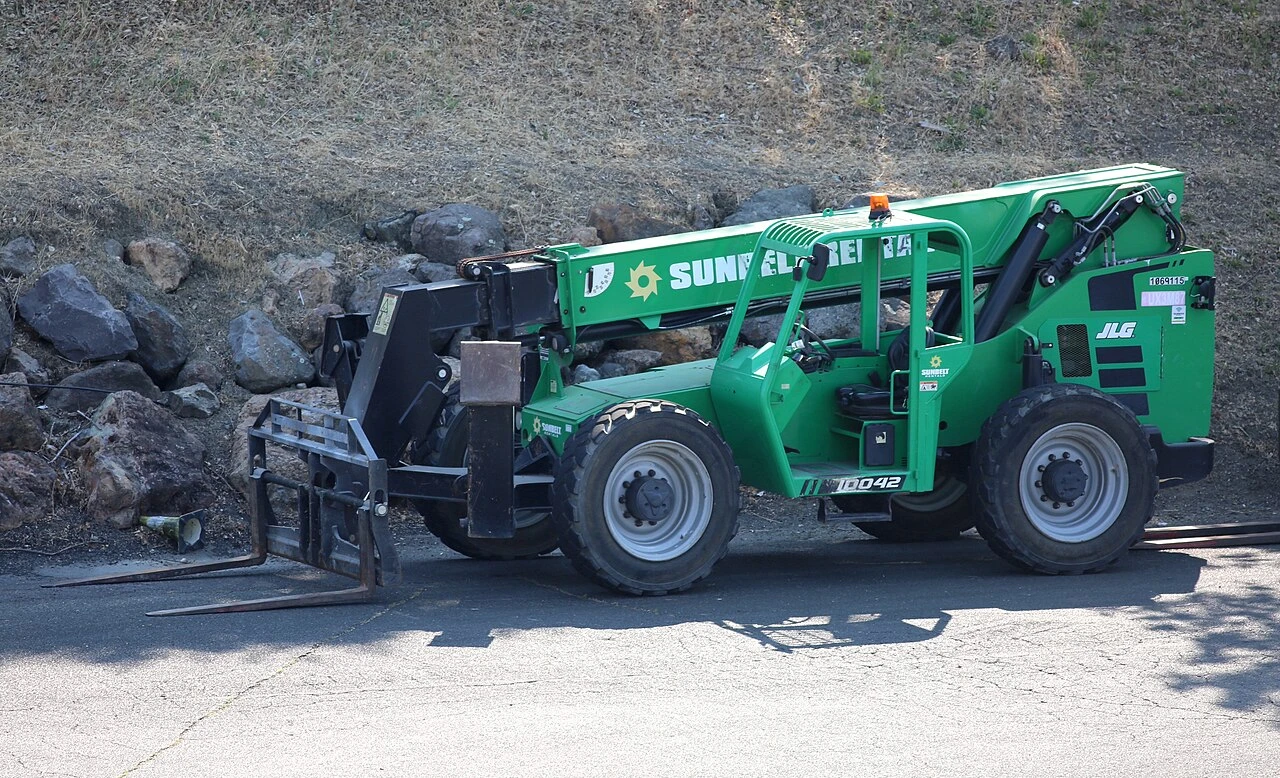

An ex-rental machine has good and bad sides.
- The good. Big fleets service on a schedule and keep printouts. Ask for the full work order history by serial number.
- The bad. Dozens of operators ran it, and none of them owned it. Expect bumped booms, chewed tires and worn fork heels.
- The tell. A fleet number painted over or a decal peeled off is normal. A missing serial plate is not. Walk away from that one.
Cat Used, the dealer side of Caterpillar, lists the maintenance file as one of its five checks. We agree. On an ex-rental unit, that file usually exists. Ask until you get it.
Check 1. The Boom Wear Pads
A telehandler boom is tubes that slide inside each other. Plastic wear pads keep the steel apart. When the pads wear out, the boom rattles, sags and starts to gall.
Genie's maintenance manual for the GTH-636 sets a boom wear pad check every quarter. The upper pads have grooves cut in their ends. If you can't see the grooves, both pads are done. Each side pad must measure more than 0.04 inch, or 1 mm. One side pad under that means all of them get replaced (Genie GTH-636 Maintenance Manual, September 2016).
- Extend and look. Run the boom fully out. Shine a light at each section end and find the pads.
- Feel for slop. With the boom out, push the carriage side to side. A clunk between sections means thin pads.
- Read the paint. Bright scrape lines along the sides of a section mean metal touched metal.
Pads are a normal wear part. Scored or bent boom sections are not. Know the difference before you price it.
Check 2. The Boom Chains
Many telehandler booms use chains to pull the inner section in and out with the middle one. Chains stretch as their pins wear. A stretched chain can fail under load.
The same Genie manual sets a chain check every quarter. It says a boom chain's normal life is a maximum of 3 percent stretch. On the GTH-636 with BL666 chain, you measure 16 links where the chain bends most over the sheaves. Over 12.36 inches, or 313 mm, the machine comes out of service until the chain is replaced.
- Ask for the number. A well kept machine has chain measurements in its records. Ask for the last one.
- Measure it yourself. Use the maker's link count and limit for that model and chain. Measure both the extend and the retract chain.
- Look at the links. Rust, kinks, cracked plates and dry chain are all bad signs. Genie notes that dusty sites may need chain lube more often.
Other makers use different chains and limits. Get the manual for the exact model before you measure.
Check 3. The Forks and Carriage
Forks look like solid steel that never wears out. They do wear, mostly at the heel where the blade bends up.
Vetter, a large fork maker, says a fork that wears more than 10 percent thinner must be replaced. At that point it has lost about 20 percent of its load capacity. It also says the two fork tips should not differ in height by more than 1.5 percent of the blade length. Cracks at the inner heel or on the mounting welds mean replace the fork (Vetter, Fork Inspection).
- Caliper the heel. Measure the blade thickness up on the shank, where it doesn't drag. Then measure at the heel. Compare the two.
- Check the tips. Lower the forks onto flat ground. Measure each tip height. Bent tips mean the forks were used to pry.
- Check the carriage. Look at the fork pins, the locks and the quick attach for cracks and slop.
New forks are not a deal breaker. A bent carriage or a cracked quick attach costs a lot more.
Check 4. Drift and the Hydraulics
Every boom motion is a cylinder. Lift, extend, tilt and frame level all hold oil under pressure. A worn seal lets the load creep.
- Warm it up first. Run the machine to full temperature. Cold oil hides tired seals and pumps.
- Hold a load. Pick up a pallet you know the weight of. Raise it partway and extend the boom. Shut the engine off and watch for a few minutes.
- Watch for creep. The boom should not sink and should not slide in. The forks should not tip down.
- Time the cycles. Raise, extend and retract fully, cold and then hot. A big slowdown when hot points to a worn pump.
- Read the hoses. Look for wet fittings and hoses rubbed through inside the boom.
One leaking cylinder is a reseal. Drift on every function points to the pump or the valve. Price those very differently.
Check 5. Frame Level, Sway and Stabilizers
Most telehandlers can tilt the frame side to side to level on a slope. Bigger units add stabilizers up front. Both keep the load inside the chart.
- Run the level both ways. It should move smoothly to each end and hold there.
- Hold test. Set the frame tilted and leave it a few minutes. It should not settle back.
- Check the stabilizers. Lower them until the front tires lift. Shut down and watch for settling. Look for bent legs and cracked pads.
- Look at the pivot. The rear axle pivot takes a beating. Check for slop and cracked mounts.
A machine that won't level or hold on stabilizers isn't safe at full reach. Fix that before it works, not after.
Check 6. The Load Chart and Attachments
A telehandler's capacity changes with every boom angle and reach. The load chart in the cab says what it can lift where. A wrong chart is a safety problem and a value problem.
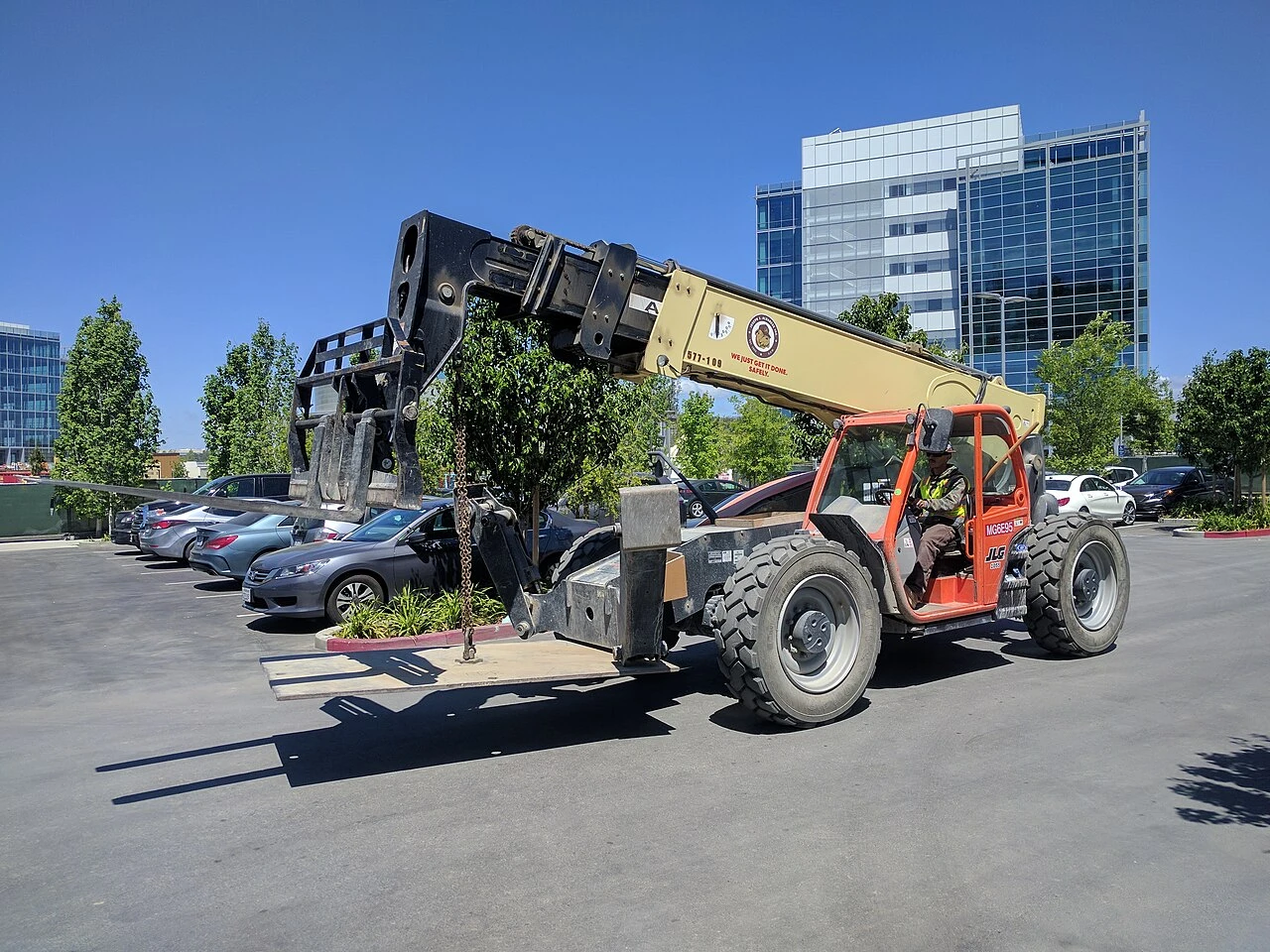

OSHA's powered industrial truck rule backs this up. Changes that affect capacity need the maker's written approval first, and the plates and decals must be updated. A truck with front end attachments other than factory ones should be marked to show them (OSHA, 29 CFR 1910.178).
- Find the charts. There should be a chart in the cab for each attachment the seller is including.
- Match the attachment. Each bucket, jib or platform should carry its own ID plate that matches a chart.
- Test the load system. Many machines have a load warning or cutout system. If this one does, ask the seller to show it working with a real load.
- Look for home welding. Welded hooks, cut forks or a homemade jib are red flags. They break the chart.
Check 7. Axles, Steering and Brakes
Telehandlers drive a lot. They cross rough sites all day with weight up front. Axles, steering and brakes wear with every trip.
- Try every steer mode. Most have front steer, round steer and crab steer. Switch through each one. The wheels should line back up when you return to front steer.
- Rock the wheels. Lift each end off the ground if you can do it safely. Rock each tire top to bottom. Play means worn kingpins or bearings.
- Drive it loaded. Climb a grade with a load. Engine revs that climb while speed stays flat mean the transmission is slipping.
- Stop on a slope. Use the service brakes, then set the park brake. It should hold.
- Read the tires. Foam filled tires are heavy and costly. Uneven wear can point to a bent axle or bad alignment.
OSHA wants industrial trucks examined at least daily before use, and after each shift on round the clock work. Ask if the seller kept those daily sheets. Few do, but a stack of them says a lot.
Check 8. The Engine Label
This check is free and can kill the deal in a minute. If the telehandler will ever work in California, the engine tier matters.
CARB's off-road rule covers diesel off-road machines of 25 horsepower or more used in the state. Since January 1, 2024, no fleet may add a Tier 3 engine. Large and medium fleets may add only Tier 4 Final or cleaner (CARB, In-Use Off-Road Diesel-Fueled Fleets Regulation Overview, January 2024).
Some machines fall outside that. Personal use, farm only use and machines held for sale are exempt. A low-use machine under 200 hours a year still has to be reported.
The seller has to put a set disclosure on the bill of sale. Read the engine label yourself and write down the model year and tier. Don't trust the listing.
The Whole Checklist on One Page
Save this to your phone before you go.
| Check | What to do | Walk away or price it in if |
|---|---|---|
| Hours and age | Compare hours to about 300 a year | Hours far off the age with no records |
| Rental history | Get work orders by serial number | No serial plate or no history at all |
| 1. Boom wear pads | Extend, light, push side to side | No grooves left or galled steel |
| 2. Boom chains | Measure stretch on both chains | Over the maker's limit or kinked links |
| 3. Forks and carriage | Caliper the heel and check tip height | 10 percent thinner or cracked at the heel |
| 4. Hydraulics | Hold a load, engine off, hot | Boom sinks, slides in or tips |
| 5. Frame level and stabilizers | Tilt, hold, lift the front tires | Won't hold or a leg is bent |
| 6. Load chart and attachments | Match each attachment to a chart | Missing charts or home welding |
| 7. Axles, steering, brakes | Every steer mode, loaded climb, slope stop | Slipping, play or a weak park brake |
| 8. Engine label | Write down the tier and model year | You need it in California and can't add it |
Read These Too
Looking at a common model? Start with its guide.
- JLG 1055 telehandler inspection guide
- SkyTrak 10042 telehandler inspection guide
- Genie GTH-636 telehandler inspection guide
- How many hours is too many on a used forklift
- 9 checks to run before buying used heavy equipment
Want a second set of eyes? Our telehandler inspection covers the boom, the forks and the load chart system on site. We work for the buyer, never the seller.
Where the Facts Live
| What we cited | Where it came from |
|---|---|
| How Much Are Equipment Types Used?, December 17, 2014 | Rental Equipment Register, from EquipmentWatch sale records, accessed October 2026 |
| Renters and Buyers Keep Telehandlers Flying High, Frank Raczon, March 25, 2016 | Construction Equipment magazine, accessed October 2026 |
| 5 Tips and What to Look For When Buying a Used Telehandler, April 1, 2021 | Cat Used, Caterpillar, accessed October 2026 |
| GTH-636 Maintenance Manual, part 1272858, September 2016, wear pad and chain checks | Genie, a Terex brand, via ManualsLib, accessed October 2026 |
| Fork Inspection | Vetter fork maker, accessed October 2026 |
| 29 CFR 1910.178, Powered Industrial Trucks | Occupational Safety and Health Administration, accessed October 2026 |
| In-Use Off-Road Diesel-Fueled Fleets Regulation Overview, revised January 2024 | California Air Resources Board, accessed October 2026 |
FAQ
- How many hours is a lot on a telehandler?
- Judge hours against age. EquipmentWatch sale records put the telehandler average near 300 hours a year, so a 10 year old machine near 3,000 hours is normal. Far more than that means hard use, so the service file has to back it up.
- Should I buy an ex-rental telehandler?
- It can be a good buy. Most telehandlers go into rental fleets first, and big fleets keep service records. Expect cosmetic damage and worn forks, and ask for the work order history by serial number.
- How do you know if telehandler wear pads are worn?
- On the Genie GTH-636, the upper pads have grooves in their ends. When the grooves are gone, both pads get replaced. Side pads must measure more than 0.04 inch, or 1 mm.
- When should telehandler forks be replaced?
- Fork maker Vetter says replace a fork once it wears more than 10 percent thinner, since it has lost about 20 percent of its capacity. Cracks at the heel or welds also mean replace it.
- How much can a telehandler boom chain stretch?
- Genie's GTH-636 manual puts a boom chain's normal life at a maximum of 3 percent stretch. Past the measured limit, the machine comes out of service until the chain is replaced.
Buying something used? We work for the buyer, never the seller, and hand you a photo report with a plain verdict.
Pick your equipment type and request an inspection